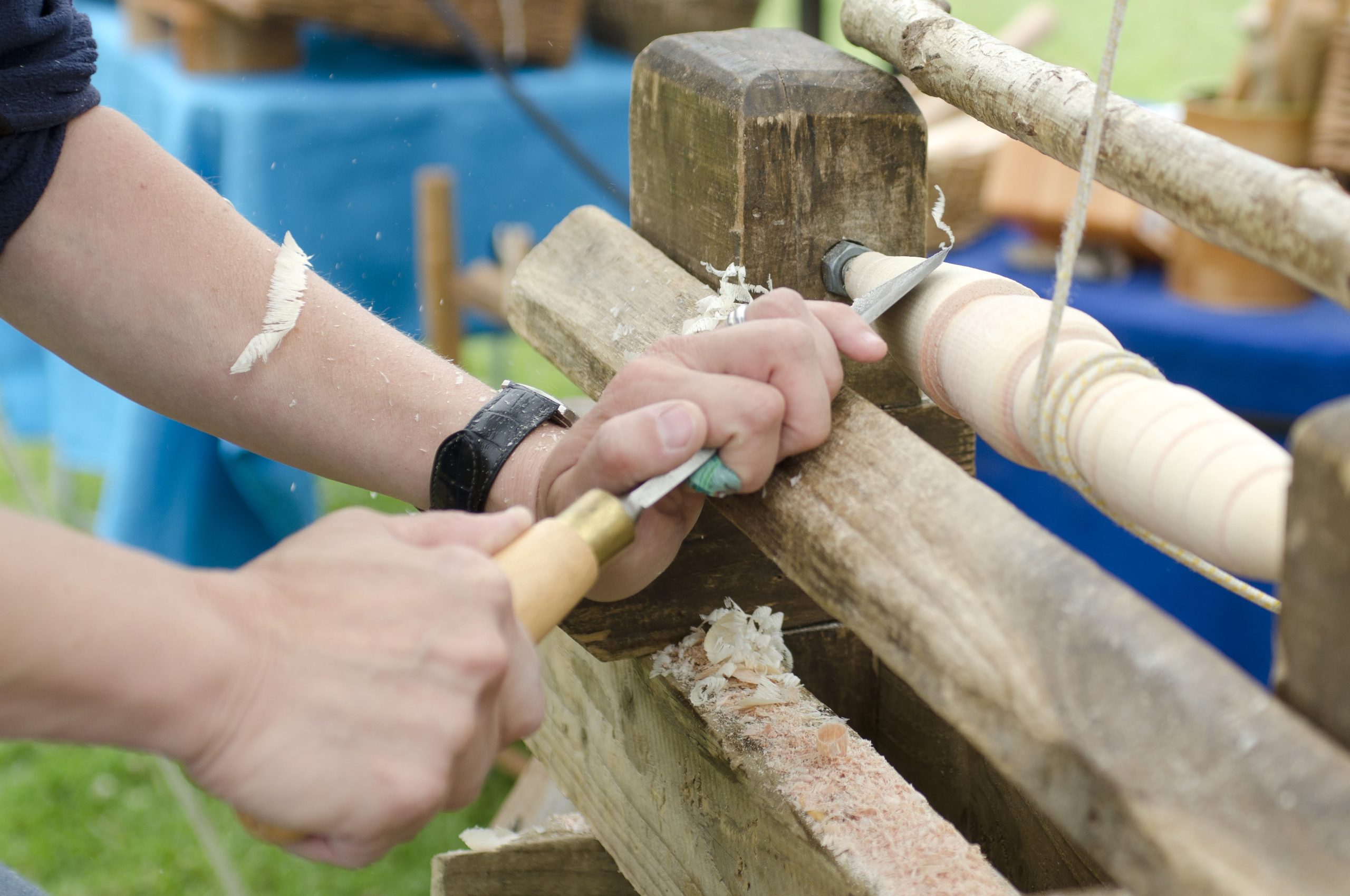
Britain’s heritage crafts are not relics. They are the practical intelligence of generations, encoded not in books but in hands: in the precise angle of a stroke, the feel of a material under the fingers, the trained eye that knows when work is done and done rightly. From the weaving of Sussex trugs to the laying of flint walls, from the coppicing of hazel to the turning of green wood on a pole lathe, each craft carries within it a form of knowledge that cannot be wholly captured in writing. It must be shown, repeated, and understood through doing. The moment a craft is no longer practised by a living person, something more than a technique is lost. A whole way of reading the landscape, a whole relationship between maker and material, quietly ceases to exist.
The Heritage Crafts Association has maintained what it calls a Red List of Endangered Crafts. First published in 2017, it ranks traditional skills by their likelihood of surviving into the next generation. The findings make sobering reading. Each revision of that list has brought new crafts into the category of critically endangered, skills that within a single lifetime have moved from common practice to near extinction. Among the causes is a familiar pattern: industrialisation displacing the hand-made, younger generations drawn toward other livelihoods, and the long chain of transmission between master and apprentice quietly breaking apart.
It is against this backdrop that our work here at the Weald & Downland Living Museum takes on a significance that goes well beyond the pleasure of a day’s outing. Set across forty acres of open downland near Chichester in West Sussex, we are a working landscape. Our reconstructed historic buildings, medieval farmsteads, Tudor cottages, a working watermill, are not stage sets. They are the context within which traditional crafts are actively practised, demonstrated, and taught to those who come willing to learn. Visitors encounter not a performance of the past but something far more vital: the past continuing, quietly and deliberately, into the present.
We work in close partnership with the Heritage Crafts Association, ensuring that our programme of courses and demonstrations is not merely enjoyable but genuinely protective of knowledge at risk. Throughout the year, skilled interpreters and craftspeople offer daily demonstrations of crafts that appear on the endangered register: charcoal burning, hedge laying, coppice working, and others whose names have become unfamiliar to most people living outside rural communities. The intention is not nostalgia. It is continuity. Each demonstration is an act of transmission, a moment in which understanding passes from one pair of hands to another.
The crafts themselves, when you look at them carefully, are rarely as simple as they appear. Basket weaving requires an intimate knowledge of willow varieties and the season’s growth. Thatching demands an understanding of reed, of roof pitch, of the way water moves across a surface. Timber framing is, at its heart, a sophisticated structural logic developed through centuries of observation and refinement. These are not primitive techniques that modernity has improved upon, so much as alternative forms of expertise; ones that carry with them a particular attentiveness to natural materials, to local conditions, and to the long life of things made well. A properly thatched roof, laid by skilled hands, may endure for decades. An oak-framed building, if well-maintained, may stand for centuries (as you can see with our buildings!). There is wisdom in that durability that the age of mass production has not yet surpassed.
We also extend our reach beyond the everyday visit. Through an ambitious programme of formal courses, including postgraduate degrees in timber building conservation and building conservation, we train a new generation of practitioners equipped to care for the historic built environment. These are not simply academic qualifications. They are, in the truest sense, a kind of apprenticeship in reading the landscape of the past and tending it with the care it deserves. This extends access to these crafts to those who might not otherwise find their way to them, ensuring that the doors of this inheritance remain open.
There is, perhaps, a broader truth embedded in all of this. Heritage crafts matter not simply because they are old, nor because they are beautiful, though they are often both. They matter because they represent a form of human relationship with the material world that is patient, attentive, and deeply grounded in place. Each craft belongs to a particular landscape, the flint of the South Downs, the coppiced chestnut of the Weald, the water meadows that once sustained the reed cutter’s trade. To lose these skills is to lose not only a technique, but a way of inhabiting the land, a way of understanding what it means to make something that will last.
The work of remembering is never finished. Each generation must choose, afresh, what it considers worth preserving. In the workshops and working fields of our Museum, that choice is being made with conviction, season after season: hands at work, knowledge in motion, the unbroken chain held carefully, and passed on.
This spring, step into the past and experience heritage crafts, traditional techniques and ancient practices as our ancestors did, as living history rooted in the English countryside.
To learn more about our activities, demonstrations, and events, we invite you to visit our What’s On page. Discover how history lives on through every bake, every game, and every blossom at the Weald & Downland Living Museum.